MPPT of Solar Photovoltaic Cell Using Perturb & Observe and Fuzzy Logic controller Algorithm for Buc
Optimize solar cell efficiency! Compare Perturb & Observe and Fuzzy Logic MPPT algorithms for Buck-Boost converters. Get the best performance now!
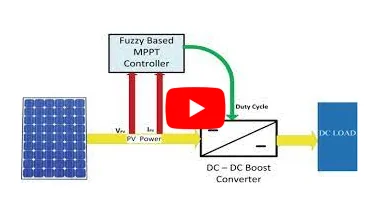
Project Methodology & Algorithm Details
Maximum Power Point Tracking (MPPT) using the Perturb & Observe (P&O) algorithm and a Fuzzy Logic Controller (FLC) in the context of a Buck-Boost DC-DC converter for solar photovoltaic (PV) cells:
- MPPT with P&O and Fuzzy Logic Controller:
- Solar PV cells exhibit non-linear current-voltage characteristics, making it essential to track the maximum power point (MPP) for efficient energy extraction.
- The P&O algorithm is a widely used MPPT technique. It perturbs the operating point (voltage or duty cycle) and observes the resulting power change. By adjusting the operating point towards the MPP, it ensures optimal power output.
- To enhance MPPT accuracy, a Fuzzy Logic Controller (FLC) can be integrated. FLC uses linguistic rules to adaptively adjust the perturbation step size based on the error between the actual power and the desired MPP power.
- The combination of P&O and FLC improves tracking efficiency, especially under varying solar insolation and temperature conditions.
Maximum Power Point Tracking (MPPT) with Fuzzy Logic Controller (FLC):In a solar PV system, the output power of a PV module depends on solar irradiance and operating temperature. Regardless of variations in climatic conditions, it’s crucial to implement MPPT controllers to obtain the maximum power.The traditional MPPT solution often uses the Perturb & Observe (P&O) algorithm. However, P&O suffers from oscillation problems around the operating point.
The Fuzzy Logic Controller (FLC) offers an alternative approach. Here’s how it works:Design and Modeling: The FLC is designed and modeled using tools like Matlab/Simulink. Components include the PV module, buck converter, and the fuzzy controller.Mathematical Model for PV Module: Unlike diode-based models, the FLC uses a mathematical model for the PV module. This model requires only curve-fitting parameters, simplifying the process.
Comparison with P&O: Simulation results demonstrate that the fuzzy controller outperforms P&O in terms of settling time, power loss, and oscillations at the operating point.By integrating FLC with MPPT algorithms, such as P&O, we achieve efficient power extraction from solar PV cells, ensuring optimal utilization of renewable energy.
- Buck-Boost DC-DC Converter:
- The Buck-Boost converter is commonly employed in PV systems to regulate the voltage and efficiently transfer power between the PV array and the load or battery.
- It can step up (boost) or step down (buck) the voltage, allowing adaptation to varying solar irradiance levels.
- By integrating MPPT algorithms like P&O and FLC with the Buck-Boost converter, we achieve optimal power extraction from solar PV cells, ensuring efficient utilization of renewable energy.
Need the Complete Source Code & Report for This Project?
Get fully documented code, dataset, and step-by-step guidance before your academic deadline.
Customize This Project
Direct review by PhD Lead Engineer
Related Project Demos




Need Custom Engineering Code?
Our PhD engineers provide complete MATLAB/Simulink projects with verified test cases and IEEE reports.
Order Project Solution →