Verified Laboratory MATLAB Implementation
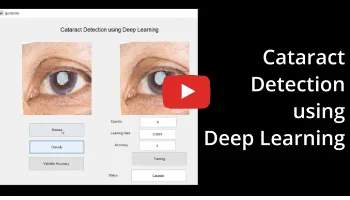
Cataract Detection using Deep Learning
Detect cataracts early with deep learning! This study explores AI-powered diagnosis for timely intervention. Learn how to protect your vision. Read now!
MATLAB Laboratory Run Demonstration
100% Tested
Environment: MATLAB R2024b / R2026 Compatible
Deliverables: .m scripts, .slx models, .mat data
Validation: Verified simulation plots & GUI App
Documentation: Full IEEE formatted project report
Project Methodology & Algorithm Details
Abstract
In a human life a very common disorder that occurs is, eye disorder named CATARACT, this eye disorder is
mostly common in humans within the age group of 40–50 years. If neglected can lead to eye blindness.
One can avoid this type of eye disorder from getting worse by detecting it on-time.
So we are proposing our model that uses Deep Learning to detect this disorder, using Fundus Images.
The model contains fully connected hidden layers with cost function and activation functions to properly
train the model and optimize it and to signi?cantly reduce the computational cost compared to other
models. Total 1130 affected and 1130 non affected images are feeded to model in order to train model
properly so that model doesn’t get overfitted.
RELATED WORKS
Modern automatic cataract detection methods comprise of three steps: feature extraction, pre-processing,
and classi?cation. Based on the algorithms employed in the feature extraction or classi?cation stages,
these techniques are divided into two groups: machine learning (ML)-based and deep learning (DL)-based
methods. These techniques have been covered in recent studies [9] -[12]. We quickly review a few of the
most important works from both groups in this section.
A. Past Works Based On Machine Learning
There are many [13] Proposed techniques for cataract identi?cation, designed for widespread screening
or as a step before classifying cataracts.The study focused on training the linear discriminant analysis
(LDA) algorithm.
using an improved texture feature.A clinical database experiment's results showed an accuracy of 84.8%.
A three-step automated cataract detection approach was proposed by Yang et al. A top to bottom hat
transition was used to increase the foreground/background contrast. Features were thought to be the
luminance and texture.
Need the Complete Source Code & Report for This Project?
Get fully documented code, dataset, and step-by-step guidance before your academic deadline.
15-Min Response
Customize This Project
Direct review by PhD Lead Engineer
Related Project Demos

Need Custom Engineering Code?
Our PhD engineers provide complete MATLAB/Simulink projects with verified test cases and IEEE reports.
Order Project Solution →