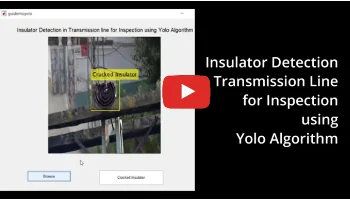
Insulator Detection in Transmission Line for Fault Inspection using Yolo Algorithm
Improve power grid reliability with YOLO! This study explores insulator fault detection in transmission lines using YOLO. Learn how AI ensures efficient faul...
Project Methodology & Algorithm Details
Detecting insulator faults in transmission lines is crucial for maintaining the reliability of electrical power systems. The YOLO (You Only Look Once) algorithm, which is a state-of-the-art object detection algorithm, can be effectively used for this purpose. Here’s a step-by-step approach to implementing insulator detection using the YOLO algorithm for fault inspection:
1. Understanding YOLO
YOLO is a deep learning algorithm that applies a single neural network to the full image. The network divides the image into regions and predicts bounding boxes and probabilities for each region. YOLO is known for its speed and accuracy, making it suitable for real-time applications.
2. Dataset Preparation
A robust and well-annotated dataset is essential for training the YOLO model. The dataset should include images of transmission lines with both normal and faulty insulators.
- Image Collection: Gather a diverse set of images of transmission lines and insulators. These can be sourced from drones, maintenance records, or public datasets.
- Annotation: Label the images with bounding boxes around insulators and classify them as normal or faulty. Tools like LabelImg can be used for this purpose.
- Data Augmentation: Enhance the dataset by applying transformations such as rotation, scaling, and flipping to improve the model’s robustness.
3. Training the YOLO Model
Training YOLO involves several steps:
- Model Selection: Choose the appropriate version of YOLO (e.g., YOLOv3, YOLOv4, YOLOv5). YOLOv5 is currently the most advanced and user-friendly version.
- Configuration: Configure the YOLO model for your specific use case. This includes setting parameters such as the number of classes (e.g., normal insulator, faulty insulator).
- Pre-trained Weights: Use pre-trained weights as a starting point to leverage transfer learning, which can significantly reduce training time and improve accuracy.
- Training: Train the model on the annotated dataset. This involves feeding the images and labels into the YOLO network, adjusting the learning rate, batch size, and other hyperparameters to optimize performance.
4. Evaluation and Testing
After training, evaluate the model’s performance using metrics such as precision, recall, and F1 score.
- Validation Set: Use a separate validation set to tune hyperparameters and avoid overfitting.
- Test Set: Evaluate the final model on a test set to ensure it generalizes well to unseen data.
- Visualization: Visualize the model’s predictions to inspect how well it detects insulators and identifies faults.
5. Deployment
Once the model is trained and evaluated, it can be deployed for real-time fault detection.
- Integration: Integrate the YOLO model into a real-time monitoring system. This can involve embedding the model in a drone or a ground-based inspection system.
- Optimization: Optimize the model for deployment, which may include reducing model size, improving inference speed, and ensuring compatibility with hardware.
- Monitoring: Continuously monitor the system’s performance and update the model with new data to maintain accuracy.
6. Challenges and Considerations
- Data Quality: High-quality annotated data is crucial for model accuracy.
- Environmental Conditions: Variations in lighting, weather, and image quality can affect detection performance.
- Hardware Limitations: Real-time detection requires efficient hardware capable of handling YOLO’s computational demands.
Need the Complete Source Code & Report for This Project?
Get fully documented code, dataset, and step-by-step guidance before your academic deadline.
Customize This Project
Direct review by PhD Lead Engineer
Related Project Demos


Need Custom Engineering Code?
Our PhD engineers provide complete MATLAB/Simulink projects with verified test cases and IEEE reports.
Order Project Solution →